
Strata Building Management
Lesson 1: Strata in Australia and who does what
Goal: explain what a strata scheme is, and say who does what in a building, including where your job starts and stops.
What strata title is
Strata title lets people own part of a building. Each owner holds a lot (usually an apartment, sometimes with a car space or storage cage), and all the owners together own the common property: the land, the structure, the foyer, lifts, roof, pool, driveways and pipes that serve more than one lot.
NSW introduced strata title in 1961, and every state and territory has since adopted its own version. Today strata ranges from a duplex sharing a driveway to towers of several hundred lots with shops on the ground floor.
Three ideas sit underneath almost everything in this course:
- Lot and common property have different owners. A lot belongs to its owner. Common property belongs to all the owners together, through the body corporate (or owners corporation, or strata company: the name depends on the state).
- The owners decide things together. Big decisions are made by the owners at general meetings; day-to-day decisions are delegated to an elected committee.
- Each owner pays a share. Levies (contributions) are set by the owners and split by lot entitlement, a number recorded for each lot when the scheme was registered.
The cast
| Who | What they do | Who they answer to |
|---|---|---|
| Lot owners | Own their lots; vote at general meetings; pay levies | Each other, through the body corporate |
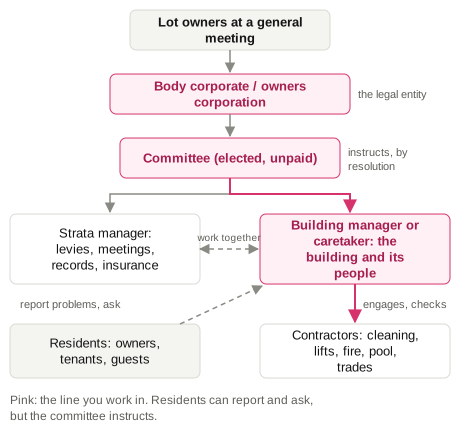
| Body corporate / owners corporation | The legal entity made up of all the owners. Owns and must maintain common property, holds the insurance, makes by-laws, hires people | The owners at general meetings |
| Committee | Elected owners (and sometimes others) who make day-to-day decisions between meetings. Unpaid | The owners |
| Strata manager | A paid professional who runs administration: levies, budgets, meetings, records, insurance renewals, notices. Usually manages dozens of schemes from an office | The body corporate, through the committee |
| Building manager / caretaker | Looks after the physical building and the people in it, usually onsite. That’s you | The body corporate, through the committee |
| Letting agent / onsite manager | Rents out lots for the owners who choose to use them (permanent or holiday). In Queensland usually the same person as the caretaker (see the Queensland management rights elective) | Each owner whose lot they let, plus the body corporate’s authorisation |
| Contractors | Trades and services: cleaning, gardening, lifts, fire, pool, plumbing, electrical | Whoever engaged them (often you, on the body corporate’s behalf) |
| Residents | Owners who live there, plus tenants and short-stay guests | The by-laws, and their landlord if renting |
Strata manager or building manager?
People mix these two up all the time, including the residents who ring you about their levy notice. Roughly:
| Strata manager | Building manager |
|---|---|
| Office-based | Onsite, or visits often |
| Money: levies, budgets, invoices paid, trust accounts | Spending within your delegated limit, checking work before invoices are paid |
| Meetings, minutes, notices, records, by-law enforcement paperwork | Reports to the committee; evidence for by-law breaches |
| Insurance policy and claims lodgement | Making safe, photos and quotes for claims |
| Licensed or registered in most states | Usually not licensed as such (Queensland letting agents and NSW rules are the exceptions: Lessons 3 and 4) |
Industry practice: in a small scheme there may be no building manager at all: the committee rings tradespeople itself. In a large tower there may be a building manager, assistants, a concierge, a facilities manager for the commercial lots and a security firm. The job in this course is the middle: one person or a small team responsible for the building.
You work for the body corporate
This is the most important idea in the lesson. Your client is the body corporate, acting through its committee. Not the chairperson personally, not the owner who rings most often, not the strata manager.
In practice that means:
- Instructions come from the committee (or a person the committee has authorised), ideally in writing.
- Individual owners can ask, complain and report, and you should respond helpfully, but they can’t direct your work on common property.
- Work inside a lot is the owner’s business, paid by the owner, unless it’s something the body corporate must maintain (Lesson 5).
- If the chair tells you one thing and the committee resolved another, the resolution wins.
Practitioner tip: keep a one-page “who can instruct me” note: the committee members, what the committee has delegated to whom, your spending limit, and the strata manager’s contact. Update it after every AGM.
At Banksia Court
In your first week, three people call you. The owner of lot 34 wants you to fix her dishwasher. The treasurer wants the pool heater replaced before summer. A tenant says the car park gate is jammed open.
- The dishwasher is inside a lot and belongs to the owner: you can suggest a tradesperson, but it’s not body corporate work.
- The pool heater is common property, but a replacement probably costs more than your spending limit. One committee member can’t approve it alone: it goes to the committee, with quotes (Lesson 8).
- The gate is common property, it’s a security risk and it’s probably within your limit. Deal with it today.
On the job 1
Draw your building’s cast: write each role in the table above with a real name and phone number (or “none” if that role doesn’t exist). Then write down who can instruct you, and how. If you can’t answer that, it’s the first thing to sort out with the committee.
Sources
- Easthope, H. (2019), The Politics and Practices of Apartment Living, Edward Elgar (strata history and governance in Australia)
- Strata Community Association Queensland, Strata terminology across Australia
- Queensland Government, Body corporate: roles and responsibilities
- NSW Government, Strata schemes
General education, not legal advice. Strata law is different in every state and territory and it changes often (NSW and Victoria both changed theirs in 2025 and 2026), so check the current Act and your own agreement, and get advice before acting on anything here.