
Strata Building Management
Lesson 8: Tradespeople I: finding, checking and quoting
Goal: build a reliable panel of tradespeople, check they’re licensed and insured, write a scope of works that gets comparable quotes, and follow the body corporate’s spending rules.
Why this goes wrong so often
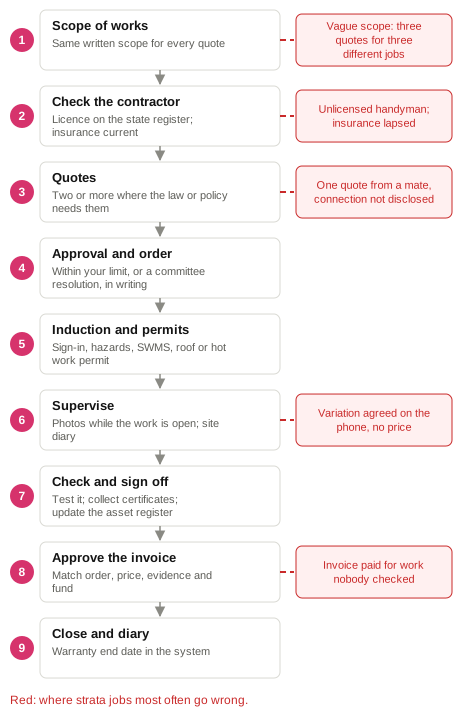
Ask any strata lawyer where trouble starts and you’ll hear the same list: an unlicensed handyman doing building work, a contractor with no insurance who falls off a ladder, a job approved on one quote from the manager’s mate, a vague scope that doubled in price, an invoice paid for work never checked. Each is avoidable with a few habits. This lesson and the next are those habits.
Build a panel
Industry practice: keep an approved list of tradespeople for the building, two or three per trade where you can, so you’re never stuck with one who knows you have no choice.
Good sources: other building managers (the best reference there is), the strata manager’s list, your SCA or industry association network, the contractors already servicing your lifts and fire systems (who know other good trades), and online reviews as a last resort.
For each contractor on the panel, keep a file:
| Item | Check |
|---|---|
| Business name, ABN, contact | ABN Lookup |
| Licence for the work they do | State register (table below), at least yearly and before big jobs |
| Public liability insurance | Certificate of currency, usually at least $10 million (many buildings require $20 million), and the expiry date |
| Workers compensation | Certificate if they have employees; sole traders should have their own personal accident cover |
| WHS documents | Safe work method statements (SWMS) for high-risk construction work; induction completed (Lesson 12) |
| Rates | Hourly, call-out, after-hours, materials margin |
| Performance notes | Response times, quality, communication, problems |
Practitioner tip: insurance certificates expire quietly. Put every expiry date in your calendar with a reminder a month before, or use a system that chases contractors for renewals automatically. “Their insurance lapsed two weeks before the accident” is a sentence you never want to read in an incident report.
Licences: the law
The law: every state licenses building work and the specialist trades, but the thresholds and names differ. Some examples:
| State | When a building licence is needed | Specialist trades (any value) | Where to check |
|---|---|---|---|
| Qld | Building work over $3,300 (labour and materials, including GST) | Plumbing, drainage, gas fitting, fire protection, pool safety and more; electrical through the Electrical Safety Office | QBCC licence search |
| NSW | Residential building work over $5,000 (labour and materials, including GST) | Electrical, plumbing, drainage, gas fitting, air-conditioning and refrigeration | NSW licence check |
| Vic | Registration for larger domestic building work, plus licensing of plumbers and electricians | Plumbing, electrical, gas | Building and Plumbing Commission (formerly the VBA); Energy Safe Victoria |
| Other states | Each has its own thresholds | Electrical, plumbing and gas everywhere | The state electives list each register |
Two traps catch building managers:
- Splitting jobs. Three invoices of $3,000 for one $9,000 job doesn’t avoid a licence requirement. The test is the value of the whole job.
- The handyman. A handyman is fine for changing light globes and tightening door handles. The moment it’s electrical, plumbing or building work over the threshold, they need the licence. Unlicensed work can void insurance and warranties, and you can be liable for arranging it.
The scope of works
A scope of works says exactly what you want done. Without one, three quotes are three different jobs and the cheapest is often the one that left the most out.
A useful scope covers:
- Location and extent: which areas, how many, measurements, a plan or marked photos.
- What to do: remove, supply, install, test, using what standard or specification.
- Materials: brand and grade, or “equivalent approved by the body corporate”.
- What’s included: access equipment, waste removal, making good, cleaning, permits, certificates.
- What’s excluded, so it’s not a surprise later.
- Access and working hours: by-law hours for noisy work, lift booking, resident notice periods.
- Safety: asbestos register, roof access procedure, SWMS required.
- Completion: what you need at the end: certificates, warranties, as-built drawings, photos.
- Timeframe, and how variations will be approved (Lesson 9).
For larger or technical works (facade repairs, waterproofing, roof replacement), the scope should be written by a consultant, such as a building surveyor, engineer or remedial building consultant. Paying for a good scope usually saves more than it costs, because it stops the cheapest tenderer from defining the job.
Getting quotes
The law: some states require multiple quotes above a set amount:
- Queensland: before the committee can approve spending above the scheme’s major spending limit (which depends on the number of lots and can be changed at a general meeting), it must get at least two quotes, unless that’s impractical. Motions to a general meeting over that limit need two quotes too.
- NSW: since 2024, the owners corporation must get at least two quotes from unrelated providers for proposed spending over $30,000 on common property.
- Other states: the Act, regulations or the scheme’s own policy may set rules; even where they don’t, two or three quotes for anything significant is industry practice.
Making quotes comparable:
- Send the same written scope to every contractor.
- Offer a site visit at the same time to all of them (it saves answering questions three times).
- Set a closing date.
- Compare in a table: price, inclusions and exclusions, timeframe, warranty, licence and insurance checked, any related-party disclosure.
- Recommend one with reasons. The cheapest isn’t always the right answer, but if you recommend a dearer one, say why.
Related parties: if you have any connection with a quoting contractor (family, friendship, shared business), disclose it in writing before the committee decides (Lesson 4). In NSW it’s now a statutory duty.
Who approves?
| Value | Usual approval |
|---|---|
| Within your delegated limit | You, then report it |
| Above your limit, within the committee’s | Committee resolution |
| Above the committee’s limit (or anything the Act reserves) | General meeting of owners |
| From the sinking or capital works fund | Check: some schemes and states need specific approval for capital works spending |
Get approvals in writing, and don’t let work start until the approval and order are issued.
At Banksia Court
Six corridor carpets are worn out. You write a scope (levels 1 to 6, measurements attached, commercial grade carpet tiles in a named range or equivalent, removal and disposal included, fire rating certificate for the floor covering, works between 8 am and 4 pm, one level at a time). Three carpet layers quote: $31,000, $36,500 and $28,000. The $28,000 quote excludes removal of the old carpet and floor preparation. Adjusted, it’s $34,000. You recommend the $31,000 contractor. In NSW the two-quote rule applies; in Queensland it depends on the major spending limit; either way, the committee gets all three with your comparison.
On the job 8
Set up a contractor file for your five most-used trades. Check each licence on the state register and each insurance certificate’s expiry, and put the expiry dates in your calendar. Then write a scope of works for the next job you need to quote.
Sources
- QBCC, When you need a licence
- NSW Government, Categories and classes of building and trade work
- NSW Government, Checking your contractor or tradesperson is qualified
- NSW Registrar General (2023), Strata legislation amendment bill passes in NSW Parliament (two quotes over $30,000)
- LookUpStrata, Queensland: two quotes required for body corporate contracts
- Safe Work Australia, Model WHS laws
General education, not legal advice. Strata law is different in every state and territory and it changes often (NSW and Victoria both changed theirs in 2025 and 2026), so check the current Act and your own agreement, and get advice before acting on anything here.