
Strata Building Management
Lesson 12: Work health and safety
Goal: work out who has WHS duties in your building, run your own work safely, manage contractors’ safety, and know what to do after a serious incident.
Which law applies
The law: every state and territory except Victoria has adopted the model WHS laws (a Work Health and Safety Act and regulations, with local variations). Western Australia was the last to adopt them, in 2022. Victoria has its own Occupational Health and Safety Act 2004, built on similar ideas with different terms.
The central idea in the model laws is the person conducting a business or undertaking (PCBU). A PCBU must ensure, so far as reasonably practicable, the health and safety of its workers and of other people affected by its work.
Is the body corporate a PCBU?
The law: under the model laws, a strata body corporate is not a PCBU if its common property is used only for residential purposes and it doesn’t employ anyone. Two things change that:
- It employs a worker, such as a caretaker or cleaner on the payroll. Engaging contractors (a plumber, a contracted building manager) doesn’t, by itself, end the exemption.
- Its common property is used for non-residential purposes, for example shops, a restaurant or commercial lots in a mixed-use building.
Even when exempt, the body corporate still owes residents and visitors a duty of care under the general law of negligence, and the strata Acts still require it to maintain common property.
In Victoria, the OHS Act’s duties attach to employers and to people who manage or control workplaces, so the question is framed differently. Get advice for your building.
You are a PCBU
Whatever the body corporate’s status, if you run a building management business, you are a PCBU. You owe duties to:
- your own workers (employees, and any contractors you engage);
- other people affected by your work, including residents and visitors;
- and you must consult, cooperate and coordinate with other duty holders, such as the contractors you engage, who have their own duties.
A contracted building manager who engages a roof plumber is in a chain of PCBUs. Each must do what’s reasonably practicable within what it controls. “The tradie is responsible for his own safety” is only half the answer.
Managing hazards: the hierarchy of controls
The law: WHS regulations require risks to be eliminated if reasonably practicable, or otherwise minimised using the hierarchy of controls: eliminate, substitute, isolate, use engineering controls, then administrative controls, then personal protective equipment (PPE). PPE is the last resort, not the first.
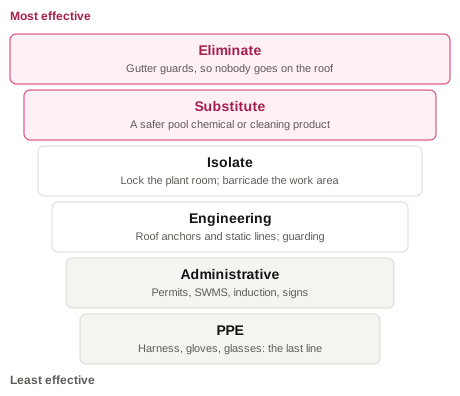
The big hazards in a strata building
| Hazard | Controls to expect |
|---|---|
| Working at heights (roofs, gutters, ladders, balconies, lift shafts) | Eliminate where possible (gutter guards, long-reach tools); certified roof anchors and static lines, inspected yearly; roof access only with a permit; ladders that are fit for the job and secured; SWMS for work over 2 metres |
| Asbestos in buildings built before 2004 | Asbestos register for workplaces built before 31 December 2003 (where the body corporate is a PCBU or the building is a workplace); check the register before any drilling, cutting or demolition; licensed removalists only |
| Electrical | Only licensed electricians; lock-out and tag-out for isolations; switchboard rooms locked |
| Confined spaces (tanks, pits, some plant rooms) | Identify and sign them; entry only by trained people with a permit |
| Hot work (welding, grinding) | Hot work permit; fire extinguisher at hand; fire watch afterwards; detector isolation arranged with the fire contractor |
| Chemicals (pool chemicals, cleaning products, pesticides) | Safety data sheets; correct storage and separation (pool acids and chlorine kept apart); PPE |
| Manual handling (bins, furniture, deliveries) | Trolleys and bin tugs; two-person lifts; job design |
| Car parks | Speed limits; lighting; pedestrian paths; convex mirrors |
| Working alone | Check-in system; a phone; know when not to go into a plant room alone |
| Aggression and psychosocial hazards | Clear complaint channels; de-escalation training; the right to walk away; support after incidents |
The law: since 2023 the model WHS regulations explicitly require PCBUs to manage psychosocial hazards (such as aggression from residents, bullying, high workloads and working alone) like any other risk. For building managers, aggressive or abusive residents are one of the main ones. Lesson 13 covers handling them.
Permits to work
Industry practice: use simple permits for the riskiest activities in the building. A one-page form, issued by you, listing who, what, where, when, the controls agreed and a sign-off when finished. Common permits: roof access, hot work, fire system isolation, confined space entry and electrical isolation.
When something goes wrong
The law: a PCBU must notify the WHS regulator immediately after a notifiable incident: a death, a serious injury or illness (for example, one needing immediate admission to hospital as an in-patient, or treatment for an amputation, serious head injury or serious burn), or a dangerous incident (such as an uncontrolled escape of gas, a fall of a significant object, the collapse of a structure, or an electric shock). The site must be preserved until an inspector arrives or says otherwise, except to help an injured person or make the site safe.
Afterwards:
- Look after the injured person and anyone affected.
- Make the area safe and preserve the scene.
- Notify the regulator if it’s notifiable, and the committee, strata manager and insurers.
- Record what happened: an incident report with photos, witnesses and the timeline (Lesson 15).
- Find out why, using the facts, and fix the system, not just blame the person at the end.
Research: James Reason’s “Swiss cheese” model of accidents shows why: serious incidents usually happen when several weaknesses line up (a missing anchor point, a rushed job, no permit, a new worker), not because of one careless act.
At Banksia Court
An air-conditioning technician arrives to service a rooftop condenser and wants to walk across the roof to it. The roof anchors were last certified 14 months ago. You don’t issue a roof access permit until the height safety company recertifies them two days later, and you add the recertification to your annual calendar. The technician grumbles; the committee backs you.
On the job 12
Write down the three highest-risk activities in your building and how each is controlled today. Then check: when were your roof anchors last certified? Is there an asbestos register, and do contractors see it before they drill?
Sources
- Safe Work Australia, Model WHS laws
- WorkSafe Queensland, Apartment owners and bodies corporate
- NT WorkSafe, Strata title bodies corporate and the WHS laws: FAQ
- WorkSafe Victoria, Summary of the Occupational Health and Safety Act 2004
- Safe Work Australia, Incident notification
- Safe Work Australia, Psychosocial hazards
- Reason, J. (2000), Human error: models and management, BMJ
General education, not legal advice. Strata law is different in every state and territory and it changes often (NSW and Victoria both changed theirs in 2025 and 2026), so check the current Act and your own agreement, and get advice before acting on anything here.