
Strata Building Management
Lesson 7: Repairs: triage, work orders and urgent work
Goal: sort incoming repair requests by urgency, raise a work order a tradesperson can act on without ringing you back, and close every job properly.
Every request goes in the system
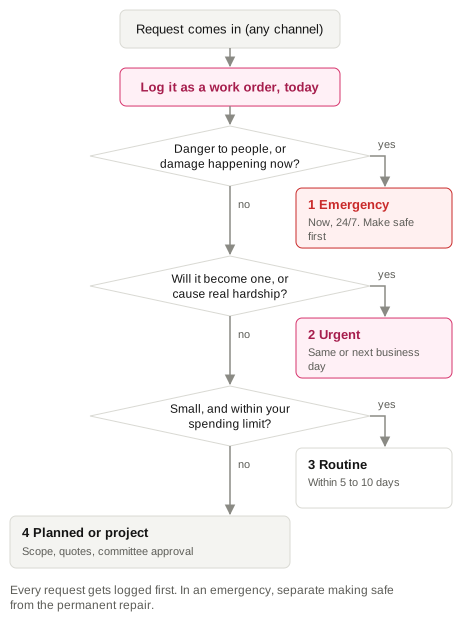
Requests reach you from everywhere: the phone, a note under the door, a conversation in the lift, an email to the strata manager forwarded three days later. The single most useful habit in this job is: every request becomes a written work order, however small, the same day.
A work order means the job can’t be forgotten, it can be followed up when you’re on leave, it builds the building’s history, and it’s your evidence when someone says “I reported that months ago”.
Triage: how urgent is it?
Industry practice: most buildings use four priorities. Write yours into your procedures and get the committee to approve them, so nobody argues about response times later.
| Priority | Examples | Respond | Who can approve |
|---|---|---|---|
| 1. Emergency (danger to people, or serious damage happening now) | Flooding, gas smell, fire system fault, lift entrapment, live wires exposed, broken glass in a walkway, security door won’t lock, sewage overflow | Immediately, 24/7. Make safe first | You, under the emergency clause; tell the committee straight after |
| 2. Urgent (will become an emergency or causes real hardship) | One lift out of two, hot water plant failed, car park gate stuck open, roof leak during rain, pool pump failed in summer | Same or next business day | You, within your limit |
| 3. Routine | Light globes, a sticking door closer, garden repairs, minor paint damage | Within your target (often 5 to 10 business days) | You, within your limit |
| 4. Planned / project | Replace corridor carpet, repaint stairwells | Scheduled | Committee, with quotes (Lesson 8) |
The law: most strata Acts let the body corporate (and so you, if your agreement delegates it) spend money on urgent work to deal with an emergency even above normal limits, then report it. The details vary by state and by your agreement. Never use “emergency” to get around a spending limit for something that could wait a day for an approval.
Make safe, then repair
In an emergency, separate making safe from repairing. Make safe now (turn off the water, cordon off the area, get a temporary repair or a security guard). Get the permanent repair quoted and approved properly. A plumber at 2 am on overtime rates should stop the flood, not re-pipe the riser.
Writing a work order
A good work order lets a tradesperson arrive, do the job and leave without phoning you. It includes:
- Building, address and access: where to park, sign-in, how to get keys or fobs, lift booking for heavy gear.
- Exact location: “Level 3 corridor, outside lot 34, ceiling light fitting second from the lift”, not “light out on level 3”.
- What’s wrong, with a photo.
- What you want: “Investigate and quote” or “Repair, up to $500 without further approval”.
- Contact for the lot if entry is needed, and the arrangement (who has consented, when).
- Safety information: asbestos register entry for the area, roof access procedure, isolation points, hot work permit if needed (Lesson 12).
- Order number they must put on the invoice.
- What to send back: before and after photos, a short report, any defects found.
Practitioner tip: templates save time and lift quality. Keep a standard work order for your top ten jobs (blocked drain, roof leak, light out, door closer) with the access and safety details already filled in.
After hours
Emergencies don’t wait for office hours. Before the first one happens:
- Have an after-hours emergency number on every lift and noticeboard. Make sure someone answers it.
- Keep a list of after-hours contractors who know the building (plumber, electrician, lift company, fire company, locksmith, glazier, security).
- Put shut-off points, plant room keys and the fire panel procedure where an after-hours contractor or deputy can find them (a locked key safe with codes held by a few people).
- Tell residents what counts as a building emergency, and what doesn’t (a blocked sink inside their lot isn’t).
Closing the loop
Most complaints about building managers aren’t about the repair. They’re about not knowing what’s happening. Practitioner tip: tell the person who reported it at three points: when you’ve logged it (with a rough timeframe), if it’s delayed, and when it’s done. A one-line text or email is enough.
Close a work order only when you have: the tradesperson’s report and photos, your own check (or a resident’s confirmation), the invoice matched to the order (Lesson 9), and any follow-up raised as a new work order.
Watch the patterns
Your work orders are data. Once a quarter, look for:
- The same problem coming back (the third blockage in the same stack this year means you need a CCTV drain inspection, not another plumber).
- Old open work orders (anything over 30 days needs a reason).
- Spending by asset (the lift that costs more in call-outs than the plan’s replacement cost).
- One contractor who’s always slow, or always finds “extra work”.
Practitioner tip: water leaks you can’t see do the most expensive damage. Leak sensors in risers, plant rooms and under hot water systems (for example FloodWatch, which sends an alert when water appears) turn a ruined ceiling into a mopped floor.
At Banksia Court
At 11 pm on Saturday a resident reports water running down the level 5 stairwell. You (or your after-hours plumber) find a burst flexible hose on a lot’s washing machine. Make safe: the plumber turns off the lot’s stop tap and fits a cap. The lot owner is away, so entry happened under your state’s emergency rule; you leave a note and email the owner and the strata manager. Monday morning: work order closed for the make safe, new work order for carpet drying in the stairwell, photos sent to the strata manager in case of an insurance claim.
On the job 7
Write down your four priorities with examples and response times, and get the committee to approve them. Then check: does every request you got last week have a work order? If not, enter them now.
Sources
- NSW Government, Strata repairs and maintenance
- Queensland Government, Body corporate maintenance responsibilities
- Stratager, Tradie Management and other strata tools
General education, not legal advice. Strata law is different in every state and territory and it changes often (NSW and Victoria both changed theirs in 2025 and 2026), so check the current Act and your own agreement, and get advice before acting on anything here.