
Strata Building Management
Lesson 5: Common property and who maintains what
Goal: work out whether a repair belongs to the body corporate or a lot owner, using the plan, the by-laws and your state’s rules, and handle the grey areas without starting a fight.
Why this matters
“Who pays?” is behind a huge share of strata arguments. If you send a plumber to fix a pipe that belongs to an owner, the body corporate pays for the owner’s repair and other owners object. If you refuse to fix a pipe that is common property, the owner suffers damage and may have a claim against the body corporate. The law: in every state the body corporate must maintain the common property in good and serviceable repair. NSW extended the time owners have to claim for losses caused by a failure to maintain from two years to six years from 1 July 2025.
Start with the plan
The registered plan shows where each lot’s boundaries are. Get a copy (the strata manager has one, or buy it from the titles office) and learn to read it.
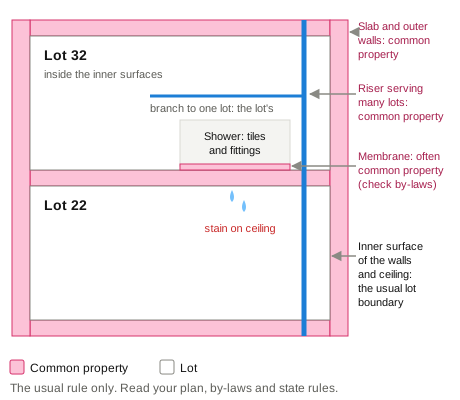
General rule (most states): in a building, a lot’s boundaries usually run along the inner surface of the walls, floor and ceiling. So:
| Usually common property | Usually part of the lot |
|---|---|
| Structure: slabs, columns, external and boundary walls | Internal non-structural walls |
| Roof and roof membrane | Floor coverings, paint and fittings inside the lot |
| Windows and balcony doors in boundary walls | Kitchen, bathroom fittings, appliances |
| Pipes and wires that serve more than one lot | Pipes and wires that serve only that lot, once inside the lot’s boundaries |
| Foyers, corridors, lifts, stairs, car park driveways | Car spaces and storage cages, if shown as part of the lot |
| Pool, gym, gardens | Courtyards or balconies shown as part of the lot |
But there are big exceptions, and they depend on the state and the plan:
- Queensland has two kinds of plan. On a building format plan, boundaries follow the building, as above. On a standard format plan (common for townhouses and villas), boundaries are surveyed lines on the ground and the lot owner owns and maintains the whole building on their lot, including the roof. Even on building format plans, the Queensland regulation modules require the body corporate to maintain some things that are inside or part of lots, such as boundary walls, doors and windows, and roofing membranes protecting lots.
- NSW schemes registered since 1974 mostly follow the inner-surface rule. Many schemes have adopted a common property memorandum, a standard by-law that sets out exactly who maintains items like balcony doors, internal plumbing fixtures and fly screens. If yours has one, use it.
- Victoria relies on the plan of subdivision, which can draw boundaries in different places (the median of walls, the exterior, or around a whole building). Read the plan; don’t assume.
- Other states broadly follow the inner-surface approach for buildings, with their own wrinkles in older schemes. The state electives cover each.
By-laws and exclusive use
Two kinds of by-law change who maintains what:
- An exclusive use by-law gives one owner the use of a piece of common property (a courtyard, a car space, a roof terrace) and usually makes them responsible for its upkeep.
- A special privilege or renovation by-law lets an owner change common property (a new balcony door, a timber floor over the slab) and usually makes them responsible for maintaining the change for ever.
Practitioner tip: keep a list of every exclusive use and renovation by-law in your building, with the lot number and what the owner must maintain. You’ll check it more often than you think.
The grey areas
| Item | Usual answer | What to check |
|---|---|---|
| Leak from a shower into the lot below | Shower waterproofing membrane is often common property (it’s part of the slab system), but the tiles and fittings belong to the lot | The plan, any renovation by-law for that bathroom, the common property memorandum (NSW) |
| Blocked drain | The pipe serving only one lot is the owner’s; once it joins pipes serving others it’s common property | Where the blockage is (a CCTV drain camera settles this) |
| Balcony tiles | Often lot property sitting on a common property slab and membrane | The plan and any by-law |
| Hot water system | Usually the owner’s if it serves only that lot | Where it sits; whether it’s central |
| Windows and balcony doors | Often common property in boundary walls; the body corporate may maintain even if owners break them | State rules and by-laws; who caused the damage |
| Air-conditioners | The owner’s unit, often installed on common property under a by-law | The by-law |
| Smoke alarms inside lots | Usually the owner’s (or landlord’s) responsibility | State smoke alarm laws; whether they’re on a building-wide system |
Leaks between lots
Water from one lot into another is the most common call you’ll get. A calm process:
- Stop the water. Find the source and isolate it if you can (lot stop tap, riser valve). Use emergency entry powers only if your state’s law allows it and it truly is an emergency (Lesson 15).
- Protect people and property. Electrical risk first. Then towels, buckets and moving furniture.
- Record. Photos with dates, where the water is coming from and going to, who was there.
- Find the cause. A plumber or leak detection specialist. Until you know the cause, nobody knows who pays.
- Decide responsibility using the plan and by-laws. Ask the strata manager if unsure.
- Repair. Body corporate items through you; lot items by the owner. If the owner won’t act and their item is damaging common property or another lot, report it to the committee for formal action.
- Insurance. If it may be a claim, tell the strata manager before any repair that removes the evidence (Lesson 15).
Entry to lots, the law: the body corporate can enter a lot to do its maintenance work, but the rules differ. In Queensland, an authorised person needs to give at least 7 days’ written notice, except in an emergency. In NSW, non-emergency entry needs the occupier’s consent or an NCAT order, and emergency entry is allowed without consent. Check your state before you go in, and never enter without either notice, consent or a genuine emergency.
At Banksia Court
Lot 22 reports brown water stains on the ceiling. Lot 32 is above. You inspect both, and the plumber finds a failed shower membrane in lot 32. Lot 32’s bathroom was renovated in 2019 under a renovation by-law that makes the owner responsible for the new waterproofing. So the repair is the owner’s, but the damage to lot 22’s ceiling may still be an insurance matter. You give both owners and the strata manager the plumber’s report and photos, and the committee issues the formal notice.
On the job 5
Get your building’s plan and by-laws. Make a “who maintains what” table for the ten items you get asked about most (start with the grey areas table above) and have the strata manager check it. Keep it handy for every phone call.
Sources
- Queensland Government, Maintenance responsibilities by format plan and Entering a lot or exclusive use area
- NSW Government, Strata schemes: repairs and maintenance
- PBL Legal, Can the owners corporation enter your lot?
- Grace Lawyers (2026), NSW strata law reforms 2023 to 2026 (six-year limitation for maintenance claims)
- Consumer Affairs Victoria, Owners corporations: property maintenance
General education, not legal advice. Strata law is different in every state and territory and it changes often (NSW and Victoria both changed theirs in 2025 and 2026), so check the current Act and your own agreement, and get advice before acting on anything here.